1. When all three types of cones are stimulated equally, a sensation of _________ light is
produced?
a) Black
b) White
c) Blue
d) Green
Explanation: White
2. Select the incorrect matching:

Explanation: Pupil – Generate action potential
3. Vitreous chamber is filled with
a) Transparent sol called vitreous humour
b) Transparent gel called vitreous humour
c) Opaque sol called vitreous humour
d) Opaque gel called vitreous humour
Explanation: Transparent gel called vitreous humour
4. Select the incorrect statement from the following:
a) Rhodopsin is also known as visual purple.
b) Rods contain a purplish-red protein, which in turn contains the derivative of Vitamin A.
c) In human eye three type of cones are present.
d) At fovea of retina, the resolution (visual acuity) is minimum.
Explanation: "At fovea of retina, the resolution (visual acuity) is minimum". This is incorrect statement.
5. The location at which Optic nerve leaves the eye balls is
a) Slightly below the posterior pole of eye ball
b) Slightly above the posterior pole of eye ball
c) Anterior pole of eye ball
d) Macula lutea
Explanation: Slightly above the posterior pole of eye ball
6. Arrange the following steps of mechanism of vision in order.
(1) Light induces dissociation of the retinal from opsin.
(2) Change in the structure of opsin.
(3) Change in membrane permeability.
(4) Potential differences are generated in photoreceptor cells.
(5) Generation of AP is ganglion cell through bipolar cells.
(6) AP is transmitted via optic nerve to visual cortex.
(7) At visual cortex, nerve impulses are analysed and the image formed on retina is recognized
based on the earlier memory and experience.
(8) Focusing of visible light on retina.
a) 8,1,2,3,4,5,6,7
b) 8,1,7,2,6,3,5,4
c) 1,2,3,4,5,6,7,8
d) 8,7,6,5,4,3,2,1
Explanation: 8,1,2,3,4,5,6,7
7. Ear performs which of the following sensory functions?
(A) Vision
(B) Olfaction
(C) Hearing
(D) Maintenance of body balance
a) A, B, C
b) B and C Only
c) C and D Only
d) C Only
Explanation: C and D Only
8. Identify A to F in the given figure.
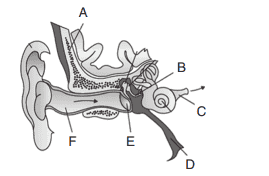
a) A–Cochlear nerve, B–Incus, C–Eustachian tube, D–Cochlea, E–External auditory canal,
F–Tympanic membrane
b) A–External auditory canal, B–Eustachian tube, C–Temporal bone, D–Steps in oval
window, E–Tympanic membrane, F–Cochlear nerve
c) A–Cochlea, B–Tympanic membrane, C–Incus, D–Cochlear nerve, E–Eustachian tube,
F–External auditory canal
d) A–Temporal bone, B–Steps in oval window, C–Cochlear nerve, D–Eustachian tube,
E–Tympanic membrane, F–External auditory canal
Explanation: A–Temporal bone, B–Steps in oval window, C–Cochlear nerve, D–Eustachian tube, E–Tympanic membrane, F–External auditory canal
9.Anatomically the ear can be divided into how many major sections?
a) 1
b) 2
c) 3
d) 4
Explanation: 3 major sections
10. Ear is divided into
a) Outer ear
b) Middle ear
c) Inner ear
d) All of these
Explanation: All of these