1. The distance between two places R and S is 42 km. Anita starts from R with a uniform speed of 4 km/hr towards S and at the same time Romita starts from S towards R also with some uniform speed. They meet each other after 6 hours. The speed of Romita is :
a) 18 km/hr
b) 20 km/hr
c) 3 km/hr
d) 8 km/hr
Explanation: Let speed of Romita be x km
According to the question,
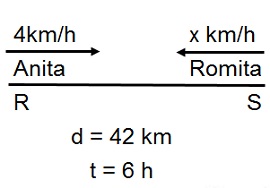
(4 + x) = $$\frac{42}{6}$$ $$\left( {{\text{S = }}\frac{{\text{D}}}{{\text{T}}}} \right)$$
4 + x = 7
x = 3 km/hr
2. Two trains 150 m and 120 m long respectively moving from opposite direction cross each other in 10 sec. If the speed of the second train is 43.2 km/hr, then the speed of the first train is :
a) 54 km/hr
b) 50 km/hr
c) 52 km/hr
d) 51 km/hr
Explanation: Let the speed of second train = x km/hr
Their relative speed in opposite direction :
= (43.2 + x) km/hr
According to the question,
$$\eqalign{ & {\text{Time = }}\frac{{{l_1} + {l_2}}}{{{\text{Speed}}}} \cr & \Rightarrow 10\sec = \frac{{\left( {150 + 120} \right){\text{m}}}}{{\left( {43.2 + x} \right) \times \frac{5}{{18}}{\text{ m/s}}}} \cr & \Rightarrow 10\sec = \frac{{270 \times 18}}{{\left( {43.2 + x} \right) \times 5}} \cr & \Rightarrow 43.2 \times 5 + 5x = 486 \cr & \Rightarrow x = \frac{{486 - 216}}{5} \cr & \Rightarrow x = 54 \cr} $$
∴ Speed of the second train = 54 km/hr
3. Two cars are moving with speed v1, v2 towards a crossing along two roads, If their distance from the crossing be 40 metres and 50 metres at an instant of time then they do not collide if their speeds are such that :
a) v1 : v2 $$ = $$ 16 : 25
b) v1 : v2 $$ \ne $$ 4 : 5
c) v1 : v2 $$ \ne $$ 5 : 4
d) v1 : v2 $$ \ne $$ 25 : 16
Explanation: The two cars will collide if their speed are in the ratio of the distance to do covered by them
Ratio of distance
= 40 : 50
= 4 : 5
For the cars not to collide :
v1 : v2 $$ \ne $$ 4 : 5
4. In a race of one kilometre. A gives B a start of 100 metres and still wins by 20 seconds. But if A gives B a start of 25 seconds, B wins by 50 metres. The time taken by A to run kilometre is :
a) 17 sec
b) $$\frac{{500}}{{29}}{\text{sec}}$$
c) $$\frac{{1200}}{{29}}{\text{sec}}$$
d) $$\frac{{700}}{{29}}{\text{sec}}$$
Explanation:Let the time taken by A to run 1000 metres = x seconds
Time taken by B to sun 900 metres = x + 20 seconds
Speed of A and B :
$$ = \frac{{1000}}{x},\frac{{900}}{{x + 20}}$$ respectively
According to the question,
$$\frac{{950}}{{\frac{{1000}}{x}}} - \frac{{1000}}{{\frac{{900}}{{x + 20}}}} = 25$$
(As B is the winner now)
$$\eqalign{ & \Rightarrow \frac{{950x}}{{1000}} - \frac{{1000\left( {x + 20} \right)}}{{900}} = 25 \cr & \Rightarrow \frac{{19x}}{{20}} - \frac{{10x + 200}}{9} = 25 \cr & \Rightarrow 171x - 200x - 4000 = 25 \times 20 \times 9 \cr & \Rightarrow 29x = 500 \cr & \Rightarrow x = \frac{{500}}{{29}}{\text{sec}} \cr} $$
5. A man travels 50 km at speed 25 km/hr and next 40 km at 20 km/hr and there after travel 90 km at 15 km/hr. His average speed is :
a) 18 km/hr
b) 25 km/hr
c) 20 km/hr
d) 15 km/hr
Explanation:
$$\eqalign{ & {\text{Average speed :}} \cr & = \frac{{{\text{Total distance }}}}{{{\text{Total time}}}} \cr & = \frac{50 + 40 + 90}{2 + 2 + 6} \cr & = \frac{180}{10} \cr & = 18{\text{ km/hr}} }$$
6. A and B travel the same distance at speed of 9 km/hr and 10 km/hr respectively. If A takes 36 min more than B, the distance travelled by each is :
a) 48 km
b) 54 km
c) 60 km
d) 66 km
Explanation: Let tistance between A and B be $$x$$ km, then
$$\eqalign{ & \frac{x}{9} - \frac{x}{{10}} = \frac{{36}}{{60}} \cr & \Rightarrow \frac{x}{{90}} = \frac{3}{5} \cr & \Rightarrow x = \frac{3}{5} \times 90 \cr & \Rightarrow x = 54\,{\text{km}} \cr & {\text{Hence option B is correct}} \cr} $$
7. Ravi and Ajay start simultaneously from a place A towards B, 60 km apart. Ravi's speed is 4 km/hr less than that of Ajay, after reaching B, Ajay turns back and meet Ravi at a place 12 km away from B, Ravi's speed is :
a) 12 km/hr
b) 10 km/hr
c) 8 km/hr
d) 6 km/hr
Explanation: Let the speed of Ravi = x km/hr
Then Ajay's speed will be = (x + 4) km/hr
Total distance, covered by Ajay :
= (60 + 12) km
= 72 km
Total distance, covered by Ravi :
= (60 - 12) km
= 48 km
According to the question,
They run at same time
$$\eqalign{ & \Rightarrow \frac{{72}}{{(x + 4)}} = \frac{{48}}{x} \cr & \Rightarrow 72x = 48x + 192 \cr & \Rightarrow 24x = 192 \cr & \Rightarrow x = 8{\text{ km/hr}} \cr} $$
Therefore, Ravi's speed = 8 km/hr
8. Walking at the rate of 4 km an hour, a man cover a certain distance in 3 hours 45 minutes. If he covers the same distance on cycle, cycling at the rate of 16.5 km/hour, the time taken by him is :
a) 55.45 minutes
b) 54.55 minutes
c) 55.44 minutes
d) 45.55 minutes
Explanation: Total distance
= $$4 \times 3\frac{3}{4}$$
= 15 km
Time taken on cycle :
= $$\frac{{15}}{{16.5}} \times 60$$
= 54.55 minutes
9. A car goes 20 metres in a second. Find its speed in km/hr.
a) 20 km/hr
b) 18 km/hr
c) 72 km/hr
d) 36 km/hr
Explanation: As we know :
⇒ 1 m/s = $$\frac{{18}}{5}$$ km/hr
⇒ 20 m/s = $$\frac{{18}}{5}$$ × 20 km/hr
= 72 km/hr
10. A train 300 m long passed a man walking along the line in the same direction at the rate of 3 km/hr in 33 sec. The speed of the train is :
a) 30 km/hr
b) 32 km/hr
c) $$32\frac{8}{{11}}$$ km/hr
d) $$35\frac{8}{{11}}$$ km/hr
Explanation: Let the speed of train = $$x$$ km/hr
Length of train = 300 mitres
Their relative speed in same direction :
= ($$x$$ - 3) km/hr
According to the question,
$$\frac{{\left( {300 + 0} \right){\text{m}}}}{{\left( {x - 3} \right) \times \frac{5}{{18}}{\text{ m/s}}}} = 33$$
[Here man's length is 0 metre]
$$\eqalign{ & \Rightarrow \frac{{300 \times 18}}{{\left( {x - 3} \right) \times 5}} = 33 \cr & \Rightarrow \frac{{100 \times 18}}{{5x \times 15}} = 11 \cr & \Rightarrow 1800 = 55x - 165 \cr & \Rightarrow 55x = 1965 \cr} $$
∴ Speed of the train :
$$\eqalign{ & \Rightarrow x = \frac{{1965}}{{55}} \cr & \Rightarrow x = 35\frac{8}{{11}}{\text{ km/hr}} \cr} $$
11. A and B run a kilometre and A wins by 25 sec. A and C run a kilometre and A wins by 275 m. When B and C run the same distance, B wins by 30 sec. The time taken by A to run a kilometre is :
a) 2 min 25 sec
b) 2 min 50 sec
c) 3 min 20 sec
d) 3 min 30 sec
Explanation: Let the time taken by A to cover 1 km = x sec
Time taken by B and C to cover the same distance = (x + 25) sec and (x + 55) sec
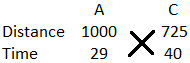
$$\eqalign{ & \frac{{\text{A}}}{{\text{C}}} = \frac{{29}}{{40}} = \frac{x}{{x + 55}} \cr & \Rightarrow 29x + 1595 = 40x \cr & \Rightarrow x = \frac{{1595}}{{11}} \cr & \Rightarrow x = 145 \cr} $$
∴ Time taken by A
= 145 sec
= 2 minutes 25 seconds
12. A moving train passes a platform 50 m long in 14 seconds and a lamp post in 10 seconds. The speed of the train (in km/hr) is :
a) 24 km/hr
b) 36 km/hr
c) 40 km/hr
d) 45 km/hr
Explanation: Let length of train be x and speed be S
S = $$\frac{x + 50}{14}$$ , also S = $$\frac{x}{10}$$
Then,
$$\frac{x + 50}{14}$$ = $$\frac{x}{10}$$
5x + 250 = 7x
2x = 250
x = 125
∴ Speed :
= $$\frac{125}{10}$$ × $$\frac{18}{5}$$
= 45 km/hr
13. A train covers a distance of 10 km in 12 minutes. If its speed is decreased by 5 km/hr, the time taken by it to cover the same distance will be :
a) 10 minutes
b) 13 minutes 20 seconds
c) 13 minutes
d) 11 minutes 20 seconds
Explanation: Speed of the train :
= $$\frac{10 × 60}{12}$$
= 50 km/hr
Now, new speed :
= 50 - 5
= 45 km/hr
And, required time :
= $$\frac{10}{45}$$
= $$\frac{2}{9}$$ × 60
= 13 minutes 20 seconds
14. Each wheel of a car is making 5 revolutions per second. If the diameter of a wheel is 84 cm, then the speed of the car in cm/sec would be :
a) 420 cm/sec
b) 264 cm/sec
c) 1000 cm/sec
d) 1320 cm/sec
Explanation: Circumference of the circle = 2πr
= 2πr
= 2 × $$\frac{22}{7}$$ × 42
= 264 cm
Distance cover in 1 sec
= 264 × 5
= 1320 cm/sec
15. P and Q are 27 km away. Two trains with speed of 24 km/hr and 18 km/hr respectively start simultaneously from P and Q and travel in the same direction. They meet at a point R beyond Q. Distance QR is :
a) 126 km
b) 81 km
c) 48 km
d) 36 km
Explanation:Relative speed = 24 - 18 = 6 km/hr
Time required by faster train to overtake slower train :
= $$\frac{27}{6}$$
= $$4\frac{1}{2}$$ hr
∴ Distance between Q and R :
= 18 × $$4\frac{1}{2}$$
= 81 km
16. A and B start at the same time with speed of 40 km/hr. and 50 km/hr respectively. If in covering the journey A takes 15 min longer than B, the total distance of the journey is :
a) 40 km
b) 48 km
c) 50 km
d) 52 km
Explanation:
$$\eqalign{ & \,\,\,\,\,\,\,\,\,\,\,\,\,\,\,\,\,\,\,\,\,\,\,\,\,\,\,\,\,\,\,\,\,\,\,\,\,\,\,\,{\text{ A }}:{\text{ B}} \cr & {\text{Ratio of speed = }}\,4\,\,:\,\,5 \cr & {\text{Ratio of time = }}\,\,\,\,5{\text{ }}:{\text{ }}4{\text{ }} \cr & (5 - 4){\text{ unit = 15 unit}} \cr & {\text{1 unit = 15 min}} \cr & {\text{So, time taken by B :}} \cr & {\text{ = 4}} \times {\text{15}} \cr & {\text{ = 60 min}} \cr & {\text{ = 1 hr}} \cr & {\text{Distance = S }} \times {\text{ T }} \cr & \,\,\,\,\,\,\,\,\,\,\,\,\,\,\,\,\,\,\,\,{\text{ = 50}} \times {\text{1 }} \cr & \,\,\,\,\,\,\,\,\,\,\,\,\,\,\,\,\,\,\,\,{\text{ = 50 km}} \cr} $$
17. A man walk a certain distance and rides back in 4 hours 30 minutes. He could ride both ways in 3 hours. The time required by the man to walk both ways is :
a) 4 hours 30 minutes
b) 4 hours 45 minutes
c) 5 hours
d) 6 hours
Explanation: Time taken to ride one way :
= $$\frac{3}{2}$$
= 1.5 hrs
Time taken to walk one way :
= 4.5 - 1.5
= 3 hrs
Time taken to walk both way :
= 3 × 2
= 6 hours
18. A man covers a total distance of 100 km on bicycle. For the first 2 hours, the speed was 20 km/hr and for the rest of the journey, it came down to 10 km/hr. The average speed will be :
a) $$12\frac{1}{2}$$ km/hr
b) 13 km/hr
c) $$\frac{1}{8}$$ km/hr
d) 20 km/hr
Explanation: Distance covered in 1st 2 hr :
= 2 × 20
= 40 km
Time taken to cover 60 km distance
= $$\frac{60}{10}$$
= 6 hours
$$\eqalign{ & {\text{Average speed}} \cr & = \frac{{{\text{Total distance}}}}{{{\text{Total time}}}} \cr & = \frac{{100}}{{2 + 6}} \cr & = \frac{{100}}{8} \cr & = 12\frac{1}{2}{\text{ km/hr}} \cr} $$
19. The diameter of each wheel of car is 70 cm. If each wheel rotates 400 times per minutes, then the speed of the car (in km/hr) if : $$\left( {{\text{Take }}\pi = \frac{{22}}{7}} \right)$$
a) 5.28 km/hr
b) 528 km/hr
c) 52.8 km/hr
d) 0.528 km/hr
Explanation: Circumference of wheel = 2πr
⇒ 2πr
⇒ 2 × $$\frac{22}{7}$$ × $$\frac{70}{2}$$
⇒ 220 cm
Speed per hours :
= $$\frac{{220 \times 400 \times 60}}{{1000 \times 100}}$$
= 52.8 km/hr
20. Two men start together to walk a certain distance, one at 4 km/hr and another at 3 km/hr. The former arrives half an hour before the latter. Find the distance :
a) 8 km
b) 7 km
c) 6 km
d) 9 km
Explanation: If the required distance be x km, then
$$\eqalign{ & \frac{x}{3} - \frac{x}{4} = \frac{1}{2} \cr & \Rightarrow \frac{{4x - 3x}}{{12}} = \frac{1}{2} \cr & \Rightarrow \frac{x}{{12}} = \frac{1}{2} \cr & \Rightarrow x = 6\,\,{\text{km}} \cr} $$
21. A car goes 10 meters in a second. Find its speed in km/hour
a) 40 km/hr
b) 32 km/hr
c) 48 km/hr
d) 36 km/hr
Explanation: Speed = 10/sec
Speed = 10 × $$\frac{18}{5}$$ km/hr
Speed = 36 km/hr
22. A bullock cart has to cover a distance of 120 km in 15 hours. If it covers half of the journey in $$\frac{3}{5}$$th time, the second to cover the remaining distance in the time left has to be :
a) 6.4 km/hr
b) 6.67 km/hr
c) 10 km/hr
d) 15 km/hr
Explanation: Total distance = 120 km
Total time = 15 hours
He covers half of the journey in $$\frac{3}{5}$$th of the time
= 15 × $$\frac{3}{5}$$ hours
= 9 hours
Now, remaining distance :
= (120 - 60) km
= 60 km
And, remaining time :
= (15 - 9) hours
= 6 hours
Average speed to cover a distance of 60 km will be :
$$\eqalign{ & = \frac{{60\,\,{\text{km}}}}{{6\,\,{\text{hour}}}} = 10\,\,{\text{km/hr}} \cr & \left\{ {{\text{Speed}} = \frac{{{\text{Distance}}}}{{{\text{Time}}}}} \right\} \cr} $$
23. A train, 110 m long is running at a speed of 60 km/hr. How many seconds does it to cross another train, 170 m long standing on parallel track ?
a) 15.6 seconds
b) 16.8 seconds
c) 17.2 seconds
d) 18 seconds
Explanation: Given :
Speed of running train = 60 km/hr
Length of running train = 110 metres
⇒ Length of standing train = 170 metres
⇒ Speed of the standing train = 0 km/hr
⇒ Time taken by running train to cross the standing train :
$$\eqalign{ & \Rightarrow {\text{Time}} = \frac{{\left( {100 + 170} \right){\text{ metres}}}}{{60{\text{ km/hr}}}} \cr & \Rightarrow {\text{Time }} = \frac{{280 \times 18}}{{60 \times 5}} \cr & \Rightarrow {\text{Time = 16}}{\text{.8 seconds}} \cr} $$
24. The distance between two cities A and B is 330 km. A train starts from A at 8 am and travels towards B at 60 km/hr. Another train starts from B at 9 am and travels towards A at 75 km/hr. At what time do they meet ?
a) 10.00 am
b) 10.30 am
c) 11.00 am
d) 11.30 am
Explanation:
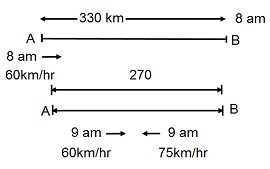
Time = $$\frac{270}{60 + 75}$$
Time = 2 hours
So, time at which they meet = 11.00 am
25. A boy stated from his house on bicycle at 10 am at a speed of 12 km per hour. His elder brother started after 1 hr 15 min on scooter along the same path and caught him at 1.30 pm. The speed of the scooter will be (in km/hr) ?
a) 4.5 km/hr
b) 36 km/hr
c) $$18\frac{2}{3}$$ km/hr
d) 9 km/hr
Explanation: Total distance covered by man in (1.30 pm - 10.00 am)
= $$3\frac{1}{2}$$ hours at a speed of 12 km/hr
= 12 × $$3\frac{1}{2}$$
= 42 km (Total distance)
Time taken by his elder brother to catch him :
= $$3\frac{1}{2}$$ - 1 hour 15 min
∴ Brother's time
= 3 hr 30 min - 1 hr 15 min
= 2 hr 15 min
= $$2\frac{15}{60}$$
= $$2\frac{1}{4}$$
= $$\frac{9}{4}$$ hours
⇒ Brother's speed :
= $$\frac{{42}}{{\frac{9}{4}}}\,\,\left( {{\text{Speed}} = \frac{{{\text{Distance}}}}{{{\text{Time}}}}} \right)$$
= $$18\frac{2}{3}{\text{ km/hr}}$$
26. A gun is fired at a distance of 1.7 km from Ram and he hears the sound after 25 seconds. The speed of sound in meter per second is
a) 60 m/s
b) 62 m/s
c) 64 m/s
d) 68 m/s
Explanation:
$$\eqalign{ & {\text{Distance = 1}}{\text{.7 km}} \cr & {\text{Time = 25 sec}} \cr & \therefore {\text{Speed = }}\frac{{{\text{Distance}}}}{{{\text{Time }}}} \cr & \,\,\,\,\,\,\,\,\,\,\,\,\,\,\,\,\,\,\,\,\, = \frac{{1.7 \times 1000}}{{25}} \cr & \,\,\,\,\,\,\,\,\,\,\,\,\,\,\,\,\,\,\,\,\, = 68{\text{ m/s}} \cr} $$
27. A man crosses a road 250 metres wide in 75 seconds. His speed in km/hr is :
a) 10 km/hr
b) 12 km/hr
c) 12.5 km/hr
d) 15 km/hr
Explanation:
$$\eqalign{ & S = \frac{D}{T} = \frac{{250}}{{75}}{\text{ m/sec}} \cr & \,\,\,\,\,\,\,\,\,\,\,\,\,\,\,\,\,\,{\text{ = }}\frac{{250}}{{75}} \times \frac{{18}}{5} \cr & \,\,\,\,\,\,\,\,\,\,\,\,\,\,\,\,\,\,\, = 12{\text{ km/hr}} \cr} $$
28. The speed of 90 km per hour is same as :
a) 9 m/s
b) 20 m/s
c) 25 m/s
d) 28 m/s
Explanation: 1 km/hr = $$\frac{5}{18}$$
∴ 90 km/hr
= 90 × $$\frac{5}{18}$$ = 25 m/s
29. A train passes two bridges of length 500 metres and 250 metres in 100 seconds and 60 seconds respectively. The length of the train is :
a) 125 metres
b) 250 metres
c) 120 metres
d) 152 metres
Explanation: Let the length of train be $$l$$ metre
According to the question,
Time = $$\frac{{{\text{Distance}}}}{{{\text{Speed}}}}$$
⇒ 100 =$$\frac{{{\text{500 + }}l}}{{{\text{Speed}}}}$$
⇒ Speed = $$\frac{{500 + l}}{{100}}$$ ..... (i)
Again,
60 = $$\frac{{{\text{250 + }}l}}{{{\text{Speed of Train}}}}$$
Speed = $$\frac{{{\text{250 + }}l}}{{{\text{60}}}}$$ ..... (ii)
Equation (i) and (ii)
$$\eqalign{ & \Rightarrow \frac{{500 + l}}{{100}} = \frac{{250}}{{60}} \cr & \Rightarrow 1500 + 3l = 1250 + 5l \cr & \Rightarrow 2l = 250 \cr & \therefore {\text{Length of train = 125 metres}} \cr} $$
30. Two trains start from a certain place on two parallel tracks in the same direction. The speed of the trains are 45 km/hr and 40 km/hr respectively. The distance between the two trains after 45 minutes will be :
a) 2.500 km
b) 2.750 km
c) 3.750 km
d) 3.25 km
Explanation: Relative speed :
$$\eqalign{ & = \left( {40 - 45} \right) \times \frac{5}{{18}} \cr & = \frac{{25}}{{18}}{\text{ m/s}} \cr} $$
∴ Required distance :
$$\eqalign{ & {\text{ = }}\frac{{25}}{{18}} \times 45 \times 60 \cr & = 3750{\text{ metres or 3}}{\text{.75 km}} \cr} $$
31. The speed of two trains are in the ratio 6 : 7. If the second train runs 364 km in 4 hours, then the speed of first train is :
a) 60 km/hr
b) 72 km/hr
c) 78 km/hr
d) 84 km/hr
Explanation: Given, Ratio of speed of trains = 6 : 7
Second train covers 364 kms in 4 hours
Then, its speed = $$\frac{364}{4}$$ = 91 km/hr
In the question it is given that speed of the second train = 7 units
But actual speed = 91 km/hr
i.e., 7 units → 91 km
1 unit → 13 km
Therefore,
Speed of the first train is :
= 6R
= 6 × 13
= 78 km/hr
32. 2 km 5 metres is equal to ?
a) 2.5 km
b) 2.005 km
c) 2.0005 km
d) 2.05 km
Explanation: We know, 1 km = 1000 metres
⇒ 2 km 5 metres = 2 km + $$\frac{5}{1000}$$ km
= 2 km + 0.005 km
= 2.005 km
33. A jeep is chasing a car which is 5 km ahead. Their respective speeds are 90 km/hr and 75 km/hr. After how many minutes will the jeep catch the car ?
a) 10 min
b) 20 min
c) 24 min
d) 25 min
Explanation:
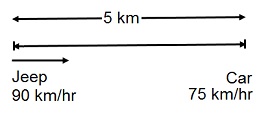
Their relative speed in same direction
= (90 - 75) kmph
= 15 kmph
Time taken by jeep to catch car :
$$\eqalign{ & = \frac{5}{15} {\text{ hour}} \cr & = \frac{1}{3} {\text{ hour}} \cr & = \frac{1}{3} \times 60 {\text{ min}} \cr & = 20 {\text{ min}} \cr}$$
34. A gun is fired from a fort. A man hears the sound 10 seconds later. If the sound travels at the rate of 330 m/sec, find the distance between the fort and the man
a) 330 km
b) 33 km
c) 3.3 km
d) 0.33 km
Explanation: Distance between the fort and the man :
= 330 × 10
= 3300 m
= 3.3 km
35. A man goes to a place on bicycle at speed of 16 km/hr and comes back at lower speed. If the average speed is 6.4 km/hr in total, then the return speed (in km/hr) is :
a) 10 km/hr
b) 8 km/hr
c) 6 km/hr
d) 4 km/hr
Explanation:
$$\eqalign{ & {\text{Average speed :}} \cr & {\text{ = }}\frac{{2xy}}{{x + y}} \cr & = \frac{{2 \times 16 \times y}}{{16 + y}} \cr & \Rightarrow 6.4 = \frac{{32y}}{{16 + y}} \cr & \Rightarrow 102.4 + 6.4 = 32y \cr & \Rightarrow 102.4 = 25.6y \cr & \Rightarrow y = \frac{{102.4}}{{25.6}} \cr & \Rightarrow y = 4{\text{ km/hr}} \cr} $$
36. Gautam goes office at a speed of 12 kmph and return homes at 10 kmph. His average speed is :
a) 11 km/hr
b) 22 km/hr
c) 10.9 km/hr
d) 12.5 km/hr
Explanation: Average speed = $$\frac{2xy}{x + y}$$
x = 10 km/hr
y = 12 km/hr
Average speed = $$\frac{{2 \times 10 \times 12}}{{\left( {10 + 12} \right)}}$$
∴ Average speed = 10.9 km/hr
37. In a race of 200 metres, B can give a start of 10 metres to A and C can give a start of 20 metres to B. The start that C can give to A, in the same race, is :
a) 30 metres
b) 25 metres
c) 29 metres
d) 27 metres
Explanation:
$$\eqalign{ & \,\,{\text{A}}\,\,\,\,\,\,\,\,\,\,\,\,\,\,\,\,\,\,\,\,\,\,\,{\text{B}}\,\,\,\,\,\,\,\,\,\,\,\,\,\,\,\,\,\,\,\,{\text{C}} \cr & 190\,\,\,\,\,\,\,\,\,\,\,\,\,\,\,\,\,200 \cr & 180\,\,\,\,\,\,\,\,\,\,\,\,\,\,\,\,\,200 \cr & \,\,{\text{A}}\,\,\,\,\,\,\,\,\,\,\,\,\,\,\,\,\,\,\,\,\,\,\,{\text{B}}\,\,\,\,\,\,\,\,\,\,\,\,\,\,\,\,\,\,\,{\text{C}} \cr & 171\,\,\,\,\,\,\,\,\,\,\,\,\,\,\,\,\,180\,\,\,\,\,\,\,\,\,\,\,\,\,\,\,\,200 \cr} $$
⇒ C can give a start of 200 - 171 = 29 metres to A
38. A car travelling with $$\frac{5}{7}$$ of its usual speed covers 42 km in 1 hr 40 min 48 sec. What is the usual speed of the car ?
a) $$17\frac{6}{7}$$ km/hr
b) 35 km/hr
c) 25 km/hr
d) 30 km/hr
Explanation:
$$\eqalign{ & {\text{Usual speed}}\,\,\,\,\,\,\,\,:\,\,\,\,\,\,\,\,{\text{New speed}} \cr & \,\,\,\mathop {\,\,\,\,\,\,\, \downarrow \times 5}\limits_{35{\text{ km/h}}}^7 \,\,\,\,\,\,\,\,\,\,\,\,\,\,\,:\,\,\,\,\,\,\,\,\,\,\,\mathop {\,\,\,\,\,\,\, \downarrow \times 5}\limits_{{\text{25 km/h}}}^5 \cr} $$
$$\because $$ Train covers 42 kms in 1 hr, 40 min, 48 sec with the speed of $$\frac{5}{7}$$ of its speed.
Then its new speed :
$$ = \frac{{{\text{Distance }}}}{{{\text{Time}}}} = \frac{{42{\text{ km}}}}{{\frac{{504}}{{300}}{\text{hr}}}}$$
\[\left\{ \begin{gathered} {\text{1 hr 40 min 48 sec}} \hfill \\ {\text{1hr + 40 min + }}\frac{{48}}{{60}}{\text{min}} \hfill \\ {\text{1 hr + }}\left( {40 + \frac{4}{5}} \right)\min \hfill \\ 1{\text{ hr}} + \frac{{204}}{5}\min \hfill \\ \left( {1 + \frac{{204}}{{5 \times 60}}} \right){\text{ hr}} = \frac{{504}}{{300}}{\text{ hr }} \hfill \\ \end{gathered} \right\}\]
$$\eqalign{ & = \frac{{42}}{{504}} \times 300{\text{ km/hr}} \cr & {\text{ = 25 km/hr}} \cr & \because 5{\text{ units = 25 km/hr}} \cr & \,\,\,\,{\text{1 unit = 5 km/hr}} \cr & \because {\text{Usual speed = 7 units}} \cr & \because {\text{Usual speed = 7}} \times {\text{5}} \cr & \,\,\,\,\,\,\,\,\,\,\,\,\,\,\,\,\,\,\,\,\,\,\,\,\,\,\,\,\,\, \,\,\,\,\,= 35{\text{ km/hr}} \cr} $$
39. The length of a train and that of a platform are equal. If with a speed of 90 km/hr the train crosses the platform in one minute, then the length of the train (in meters) is ?
a) 500 meters
b) 600 meters
c) 750 meters
d) 900 meters
Explanation:
$$\eqalign{ & {L_t} = {L_P} = l \cr & S = {\text{90 km /hr }} \cr & \,\,\,\,{\text{ = }}\frac{{90 \times 1000}}{{60}}{\text{ m/min}} \cr & \,\,\,\,\, = 1500\text{ m/min} \cr & \Rightarrow l = {L_t} = {L_P} = \frac{{1500}}{2} = 750{\text{ meters}} \cr} $$
40. The speed $$3\frac{1}{3}$$ m/sec when expressed in km/hr becomes :
a) 8 km/hr
b) 9 km/hr
c) 10 km/hr
d) 12 km/hr
Explanation: 1 m/sec = $$\frac{18}{5}$$ km/hr
$$\frac{10}{3}$$ m/sec = $$\frac{10}{3}$$ × $$\frac{18}{5}$$
= 12 km/hr
41. A moving train crosses a man standing on a platform and the platform 300 metres long in 10 seconds and 25 seconds respectively. What will be the time taken by the train to cross a platform 200 metre long ?
a) $$16\frac{2}{3}$$ seconds
b) 18 seconds
c) 20 seconds
d) 22 seconds
Explanation:
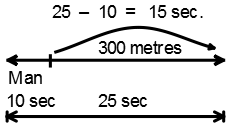
If train crosses the platform i.e., it covers the distance equal to the length of train and platform.
In the question train crosses the man who stands on the platform in 10 seconds and crosses the man + platform in 25 seconds i.e., train crosses the platform whose length is 300 metres in 25 - 10 = 15 seconds, here train's length is not added.
So, speed of the train = $$\frac{300}{15}$$ = 20 m/sec
Length of the train = 10 × 20 = 200 metres (If train crosses the only man in 10 seconds)
Time taken by the train to cross a platform 200 metre long :
$$\eqalign{ & = \frac{{{\text{ Length of train + platform}}}}{{{\text{Speed}}}} \cr & = \frac{{\left( {200 + 200} \right)}}{{20}} \cr & = \frac{{400}}{{20}} \cr & = 20 \cr} $$
Time taken by train = 20 seconds
42. If a distance of 50 m is covered in 1 minute, 90 m in 2 minutes and 130 m 3 minutes. Find the distance covered in 15th minute.
a) 610 minutes
b) 750 minutes
c) 1000 minutes
d) 650 minutes
Explanation: Distance covered in 1 min = 50 m
Distance covered in 2 min = 90 m
Similarly, 1st min, 2nd min, 3rd min . . . . . 15th
Distance → 50 m + 90 m + 130 m + . . . . . . . .
By using A.P.
a = 50 m
d = (90 - 50) = 40 m
Tn = a + (n - 1)d
= 50 + (15 - 1) × 40
= 50 + 560
= 610 minutes
43. A bus moving at a speed of 45 km/hr catches a truck 150 metres ahead going in the same direction in 30 seconds. The speed of the truck is
a) 27 km/hr
b) 24 km/hr
c) 25 km/hr
d) 28 km/hr
Explanation: Let the speed of truck is = x km/hr
Their relative speed in same direction = (45 - x) km/hr
[Here (45 - x) has been written because bus crosses the truck which is running 150 metres ahead of it. i.e., Truck speed will be lower than that of bus]
According to the question,
$$\eqalign{ & {\text{Time}} = \frac{{{\text{Distance}}}}{{{\text{Speed}}}} \cr & \Rightarrow \frac{{150}}{{\left( {45 - x} \right) \times \frac{5}{{18}}}} = 30 \cr & \Rightarrow \frac{{150 \times 18}}{{\left( {45 - x} \right) \times 5}} = 30 \cr & \Rightarrow x = 27{\text{ km/hr}} \cr} $$
44. A bus covers three successive 3 km stretches at speed of 10 km/hr, 20 km/hr and 60 km/hr respectively. Its average speed over this distance is :
a) 30 km/hr
b) 25 km/hr
c) 18 km/hr
d) 10 km/hr
Explanation:
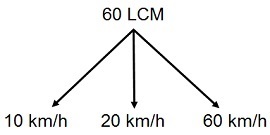
$$\eqalign{ & {\text{Average speed }} = \frac{{{\text{Total distance }}}}{{{\text{Total time}}}} \cr & {\text{Average speed}} = \frac{{60 \times 3}}{{\frac{{60}}{{10}} + \frac{{60}}{{20}} + \frac{{60}}{{60}}}} \cr & {\text{Average speed}} = \frac{{180{\text{ km}}}}{{\left( {6 + 3 + 1} \right){\text{ hr}}}} \cr & {\text{Average speed}} = \frac{{180{\text{ km}}}}{{{\text{10 hr}}}} \cr & {\text{Average speed}} = 18{\text{ km/hr}} \cr} $$
Short trick formula :
$$\left( {{\text{Average speed}} = \frac{{3xyz}}{{xy + yz + zx}}} \right)$$
45. A man walks a certain distance in certain time, if he had gone 3 km per hour faster, he would have taken 1 hour less than the scheduled time. If he had gone 2 km per hour slower, he would have taken one hour longer on the road. The distance (in km) is :
a) 60
b) 45
c) 65
d) 80
Explanation: Let the speed = x km/hr
And, time = y hr
According to the question,
x × y = (x + 3) (y - 1)
xy = xy + 3y - x - 3
x - 3y = - 3 ..... (i)
Also,
x × y = (x - 2)(y + 1)
xy = xy - 2y + x - 2
x - 2y = 2 ..... (ii)
Solve equation (i) and (ii)
x = 12
y = 5
Distance = Speed × Time
Distance = 12 × 5
= 60 km
46. A car travels from P to Q at a constant speed. If its speed were increased by 10 km/hr, it would have taken one hour lesser to cover the distance. It would have taken further 45 minutes lesser if the speed was further increased by 10 km/hr. The distance between two cities is :
a) 540 km
b) 420 km
c) 600 km
d) 620 km
Explanation: Let distance = x km and usual rate = y kmph. Then,
$$\eqalign{ & \frac{x}{y} - \frac{x}{{y + 10}} = 1 \cr & {\text{or,}}\,y\left( {y + 10} \right) = 10x\,.\,.\,.\,.\,.\,.\,.\,.\,\,\left( 1 \right) \cr} $$
Now, in the 2nd scenario with a further increase in speed the driver could have saved another 45 min = $$\frac{3}{4}$$ hrs.
Therefore, total time saved
$$ = 1 + \frac{3}{4} = \frac{7}{4}\,{\text{hrs}}{\text{.}}$$
Putting it in equation, we get
$$\eqalign{ & \frac{x}{y} - \frac{x}{{y + 20}} = \frac{7}{4} \cr & {\text{or,}}\,y\left( {y + 20} \right) = \frac{{80x}}{7}\,.\,.\,.\,.\,.\,.\,.\,.\,.\left( 2 \right) \cr} $$
On dividing (1) by (2), we get y = 60
Substituting y = 60 in (1), we get :
x = 420 km.
47. Four people are running around a circular ground from a point on the circumference at 9.00 am. For one round, these four persons take respectively 40, 50, 60 and 30 minutes. At what time will they meet together again ?
a) 4.30 pm
b) 7.00 pm
c) 6.00 pm
d) 5.30 pm
Explanation: L.C.M. of 40, 50, 60 and 30
= 600 minutes
= 10 hours
So, they meet again 10 hours after they start
i.e., 7.00 pm
48. Due to inclement weather, an Aeroplane reduce its speed by 300 km/hr and reached the destination of 1200 km late by 2 hours. Then the schedule duration of the flight was :
a) 1 hour
b) 1.5 hour
c) 2 hour
d) 2.5 hour
Explanation:Let the original speed of Aeroplane be x km/hr
$$\eqalign{ & \frac{{1200}}{{\left( {x - 300} \right)}} - \frac{{1200}}{x} = 2 \cr & \frac{{x - x + 300}}{{\left( {x - 300} \right)x}} = \frac{2}{{1200}} \cr} $$
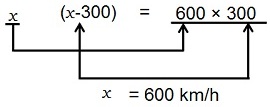
Original time :
$$\eqalign{ & t = \frac{{1200}}{{600}} \cr & t = 2{\text{ hours}} \cr} $$
49. A train, 150 m long, passes a pole in 15 seconds and another train of the same length travelling in the opposite direction in 12 seconds. The speed of the second train is :
a) 45 km/hr
b) 48 km/hr
c) 52 km/hr
d) 54 km/hr
Explanation: Speed of the first train :
= $$\frac{150}{15}$$ = 10 m/s
Time taken by trains to cross each other = 12 sec
And, relative speed of two trains :
= $$\frac{150 + 150}{12}$$
= 25 m/s
∴ Speed of the second train :
= (25 - 10) × $$\frac{18}{5}$$
= 54 km/hr
50. A man can reach a certain place in 30 hours. If he reduces his speed by $$\frac{1}{15}$$th, he comes 10 km less in that time. Find his speed in km per hour.
a) 6 km/hr
b) $$5\frac{1}{2}$$ km/hr
c) 4 km/hr
d) 5 km/hr
Explanation:
$$\eqalign{ & \,\,\,\,\,\,\,\,\,\,\,\,\,\,\,\,\,\,\,\,\,\,\,\,\,\,\,\,\,\,\,\,\,{\text{Actual}}\,\,\,\,\,\,\,\,\,\,\,{\text{Reduced}} \cr & {\text{Ratio of speed}} = {\text{15}}\,\,\,\,\,\,\,\,\,{\text{:}}\,\,\,\,\,\,\,\,\,\,{\text{14}} \cr & {\text{Ratio of time}}\,\,\, = {\text{14}}\,\,\,\,\,\,\,\,\,{\text{:}}\,\,\,\,\,\,\,\,\,{\text{15}} \cr & {\text{14}} \to {\text{28 hrs}} \cr & {\text{15}} \to {\text{30 hrs}} \cr & {\text{So, in 2 hrs it travels 10 kms}} \cr & {\text{Speed = }}\frac{{10}}{2} = 5{\text{ km/hr}} \cr} $$
51. A, B and C start at the same time in the same direction to run around a circular stadium. A completes a round in 252 sec, B in 308 sec and C in 198 sec, all starting from the same point. After what time will they again meet at the stating point again ?
a) 46 min 12 sec
b) 45 min
c) 42 min 36 sec
d) 26 min 18 sec
Explanation: Time taken by A
= 252 sec
= 22 ×32 ×7
Time taken by B
= 308 sec
= 22 × 7 × 11
Time taken by C
= 198 sec
= 2 × 9 × 11
Together will meet at starting point :
= L.C.M. (252, 308, 198)
= 22 × 32 × 7 × 11 sec
So, required time (minutes)
$$\eqalign{ & {\text{ = }}\frac{{4 \times 9 \times 7 \times 11}}{{60}} \cr & = 46\min 12\sec \cr} $$
52. A car completed a journey of 400 km in $$12\frac{1}{2}$$ hrs. The first $$\frac{3}{4}$$ of the journey was done at 30 km/hr. Calculate the speed for the rest of the journey.
a) 45 km/hr
b) 40 km/hr
c) 25 km/hr
d) 30 km/hr
Explanation:
$$\eqalign{ & {\text{Total journey = 400}} \cr & \frac{3}{4}{\text{ Journey = 400}} \times \frac{3}{4} \cr & \,\,\,\,\,\,\,\,\,\,\,\,\,\,\,\,\,\,\,\,\,\,\,\,\,\,\,\,\,\, = 300{\text{ km}} \cr} $$
Remaining journey = 100 km
Let the speed of car for the rest of journey = x km/hr
According to the question,
$$\eqalign{ & \frac{{300}}{{30}} + \frac{{100}}{x} = 12\frac{1}{2} \cr & 10 + \frac{{100}}{x} = \frac{{25}}{2} \cr & \frac{{100}}{x} = \frac{{25 - 20}}{2} \cr & x = \frac{{100 \times 2}}{5} \cr & x = 40{\text{ km/hr}} \cr} $$
53. A and B are 15 km apart and when travelling towards each other meet after half an hour where as they meet two and a half hours later if they travel in the same direction. The faster of the two travels at the speed of :
a) 15 km/hr
b) 18 km/hr
c)10 km/hr
d) 8 km/hr
Explanation:
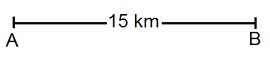
Let the speed of A be x km/hr and speed of B be y km/hr
So, According to the question,
$$\eqalign{ & \frac{{15}}{{x + y}} = \frac{1}{2} \cr & x + y = 30.....(i) \cr & {\text{And,}} \cr & \frac{{15}}{{x - y}} = \frac{5}{2} \cr & 5x - 5y = 30.....(ii) \cr} $$
Multiply equation (i) by 5 and add
\[\begin{gathered} 5x + 5y = 150 \hfill \\ 5x - 5y = \,\,\,30 \hfill \\ \overline {10x\,\,\,\,\,\,\,\,\, = 180\,\,} \hfill \\ \end{gathered} \]
$$\boxed{x = 18{\text{ km/hr}}}$$
And y = 30 - $$x$$
⇒ y = 30 -18
⇒ y = 12 km/hr
∴ The faster travels at the speed of 18 km/hr
54. Two trains of equal length take 10 sec and 15 sec respectively to cross a telegraph post. If the length of each train be 120 metres, in what time (in seconds) will they cross each other travelling in opposite direction ?
a) 16 sec
b) 15 sec
c) 12 sec
d) 10 sec
Explanation:
$$\eqalign{ & {{\text{S}}_1} = \frac{{120}}{{10}}{\text{ m/sec}} \cr & \,\,\,\,\,\,\,\, = {\text{12 m/sec}} \cr & {{\text{S}}_2} = \frac{{120}}{{15}}{\text{ m/sec}} \cr & \,\,\,\,\,\,\,\, = 8{\text{ m/sec}} \cr} $$
Time taken to cross each other :
$$\eqalign{ & {\text{ = }}\frac{{{l_1} + {l_2}}}{{{{\text{V}}_{{\text{rel}}{\text{.}}}}}} \cr & = \frac{{240}}{{20}} \cr & = 12\sec \cr} $$
55. A person, who can walk down a hill at the rate of $$4\frac{1}{2}$$ km/hr and up the hill at the rate of 3 km/hr. He ascends and comes down to his starting point in 5 hours. How far did he ascend ?
a) 13.5 km
b) 3 km
c) 15 km
d) 9 km
Explanation: Let the height of the hill = x km
$$\because $$ The distance will be same man either ascend and descend
$$\frac{{x{\text{ km}}}}{{\frac{9}{2}{\text{ km/h}}}} + \frac{x}{{3{\text{ km/h}}}} = 5{\text{ hrs}}$$
\[\left\{ \begin{gathered} \because {\text{ Time = }}\frac{{{\text{Distance}}}}{{{\text{Speed}}}} \hfill \\ {\text{Total Time = Ascending}} \hfill \\ {\text{ time + Descending time}} \hfill \\ \end{gathered} \right\}\]
$$\eqalign{ & \Rightarrow \frac{{2x}}{9} + \frac{x}{3} = 5 \cr & \Rightarrow \frac{{2x + 3x}}{9} = 5 \cr & \Rightarrow 5x = 5 \times 9 \cr & \Rightarrow x = 9{\text{ km}} \cr} $$
56. A car travels the first one-third of a certain distance with a speed of 10 km/hr, the next one-third distance with a speed of 20 km/hr, and the last one-third distance with a speed of 60 km/hr. The average speed of the car for the whole journey is :
a) 18 km/hr
b) 24 km/hr
c) 30 km/hr
d) 36 km/hr
Explanation: Let the whole distance travelled be x km and the average speed of the car for the whole journey be y km/hr
Then,
$$\eqalign{ & \Leftrightarrow \frac{{\left( {\frac{x}{3}} \right)}}{{10}} + \frac{{\left( {\frac{x}{3}} \right)}}{{20}} + \frac{{\left( {\frac{x}{3}} \right)}}{{60}} = \frac{x}{y} \cr & \Leftrightarrow \frac{x}{{30}} + \frac{x}{{60}} + \frac{x}{{180}} = \frac{x}{y} \cr & \Leftrightarrow \frac{1}{{18}}y = 1 \cr & \Leftrightarrow y = 18{\text{ km/hr}} \cr} $$
57. Two men start together to walk to a certain destination, one at 3 kmph and another at 3.75 kmph. The latter arrives half an hour before the former. The distance is :
a) 6 km
b) 7.5 km
c) 8 km
d) 9.5 km
Explanation: Let the distance be x km
Then,
$$\eqalign{ & \Leftrightarrow \frac{x}{3} - \frac{x}{{3.75}} = \frac{1}{2} \cr & \Leftrightarrow 2.5x - 2x = 3.75 \cr & \Leftrightarrow x = \frac{{3.75}}{{0.50}} \cr & \Leftrightarrow x = \frac{{15}}{2} \cr & \Leftrightarrow x = 7.5{\text{ km}} \cr} $$
58. A thief steals a car at 2.30 pm and drives it at 60 kmph. The theft is discovered at 3 pm and the owner sets off in another car at 75 kmph. When will he overtake the thief ?
a) 4.30 pm
b) 4.45 pm
c) 5 pm
d) 5.15 pm
Explanation: Suppose the thief is overtaken x hrs after 2.30 pm
The, distance covered by the thief in x hrs = Distance covered by owner in $$\left( {x - \frac{1}{2}} \right)$$ hrs
$$\eqalign{ & \therefore 60x = 75\left( {x - \frac{1}{2}} \right) \cr & \Leftrightarrow 15x = \frac{{75}}{2} \cr & \Leftrightarrow x = \frac{5}{2}{\text{ hrs}} \cr} $$
So, the theif is overtaken at 5 pm
59. Two cyclists, k kilometres apart, and starting at the same time, would be together in r hours if they travelled in the same direction, but would pass each other in t hours if they travelled in opposite directions. The ratio of the speed of the faster cyclist to that of the slower is :
a) $$\frac{{r + t}}{{r - t}}$$
b) $$\frac{r}{{r - t}}$$
c) $$\frac{{r + t}}{r}$$
d) $$\frac{r}{t}$$
Explanation: Let the speed of the faster and slower cyclists be x km/hr and y km/hr respectively
Then,
$$\eqalign{ & \frac{k}{{x - y}} = r \cr & \left( {x - y} \right)r = k.....(i) \cr & {\text{And,}} \cr & \frac{k}{{x + y}} = t \cr & \left( {x + y} \right)t = k.....(ii) \cr} $$
From (i) and (ii), we have :
$$\eqalign{ & \Rightarrow \left( {x - y} \right)r = \left( {x + y} \right)t \cr & \Rightarrow xr - yr = xt + yt \cr & \Rightarrow xr - xt = yr + yt \cr & \Rightarrow x\left( {r - t} \right) = y\left( {r + t} \right) \cr & \Rightarrow \frac{x}{y} = \frac{{r + t}}{{r - t}} \cr} $$
60. A certain distance is covered by a cyclist at a certain speed. If a jogger covers half the distance in double the time, the ratio of the speed of the jogger to that of the cyclist is :
a) 1 : 2
b) 2 : 1
c) 1 : 4
d) 4 : 1
Explanation: Let the distance covered by the cyclist be x and the time taken be y
Then, required ratio :
$$\eqalign{ & = \frac{{\frac{1}{2}x}}{{2y}}:\frac{x}{y} \cr & = \frac{1}{4}:1 \cr & = 1:4 \cr} $$
61. A train 300 metres long takes 40 seconds to cross a platform 900 metres long. The speed of the train in, km per hour is :
a) 102 km/hr
b) 104 km/hr
c) 106 km/hr
d) 108 km/hr
Explanation:
$$\eqalign{ & {\text{Speed of train :}} \cr & = \frac{{900 + 300}}{{40}} \cr & = 30{\text{ m/s}} \cr & {\text{Speed (in km/hr):}} \cr & = 30 \times \frac{{18}}{5} \cr & = 108{\text{ km/hr}} \cr} $$
62. Rubi goes to a multiplex at the speed of 3 km/hr to see a movie and reaches 5 minutes late. If she travels at the speed of 4 km/hr she reaches 5 minutes early. The the distance of the multiplex from her starting point is :
a) 2 km
b) 5 km
c) 2 m
d) 5 m
Explanation:
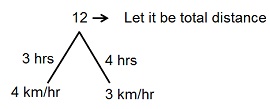
Time difference = (4 - 3) = 1 hr
But, according to the question,
60 × $$\frac{1}{6}$$ = 10 minutes
So, distance = 12 × $$\frac{1}{6}$$ = 2 km
63. A train travelling at a speed of 30 m/sec crosses a platform, 600 metres long in 30 seconds. The length (in metres) of train is :
a) 120 metres
b) 150 metres
c) 200 metres
d) 300 metres
Explanation: Total distance covered by the train in 30 seconds with the speed of 30 m/s is
= 30 × 30 m/s
= 900 metres
Total distance - train's length + platform's length
900 = train's length + 600
(when train crosses platform it covers length equal to length of train + length of platform)
Train's length = 900 - 600
Train's length = 300 metres
64. The distance between place A and B is 999 km. An express train leaves place A at 6 am and runs at a speed of 55.5 km/hr. The train stops on the way for 1 hour 20 minutes. It reaches B at :
a) 1.20 am
b) 12 pm
c) 6 am
d) 11 pm
Explanation: Time will be taken by train if it does not stop :
$$\eqalign{ & = \frac{{{\text{Distance }}}}{{{\text{Speed}}}} \cr & = \frac{{999{\text{ kms}}}}{{55.5{\text{ km/hr}}}} \cr} $$
Without stop = 18 hr
But if stops on the way for 1 hour 20 minutes before reaching B.
Total time :
= 18 hr + 1 hr 20 min
= 19 hour 20 minutes
Reaching time at B :
= 6 am + 19 hr 20 min
= 1.20 am
65. A man travels some distance at a speed of 12 km/hr and returns at a speed of 9 km/hr. If the total time taken by him is 2 hr 20 min, the distance is :
a) 35 km
b) 21 km
c) 9 km
d) 12 km
Explanation: Let the distance be x km
According to the question,
$$\eqalign{ & \frac{x}{{12}} + \frac{x}{9} = 2 + \frac{{20}}{{60}} \cr & \frac{{3x + 4x}}{{36}} = \frac{7}{3} \cr & \frac{{7x}}{{36}} = \frac{7}{3} \cr & \boxed{x = 12{\text{ km}}} \cr} $$
66. Two trains start from stations A and B and travel towards each other at a speed of 50 kmph and 60 kmph respectively. A the time of their meeting, the second train had travelled 120 km more then the first. The distance between A and B is :
a) 600 km
b) 1320 km
c) 1440 km
d) 1660 km
Explanation: At the time of meeting, let the distance travelled by the first train be x km.
Then, discount covered by the second train = (x + 120) km
$$\eqalign{ & \therefore \frac{x}{{50}} = \frac{{x + 120}}{{60}} \cr & \Leftrightarrow 60x = 50x + 6000 \cr & \Leftrightarrow 10x = 6000 \cr & \Leftrightarrow x = 600 \cr} $$
So, distance between A and B
= (x + x + 12) km
= 1320 km
67. A vehicle travels at the rate of 80 kmph. What distance will will it travel in 15 minutes ?
a) 20000 metres
b) 25000 metres
c) 24000 metres
d) 22000 metres
Explanation: Speed of vehicle = 80 kmph
$$\eqalign{ & = \left( {\frac{{80 \times 1000}}{{60}}} \right){\text{m/min}} \cr & = \left( {\frac{{4000}}{3}} \right){\text{m/min}} \cr} $$
∴ Required distance :
$$\eqalign{ & = \frac{{4000}}{3} \times 15 \cr & = 20000{\text{ metres}} \cr} $$
68. A man covered a distance of 180 km in 4 hours on a bike. How much distance will be cover on a bicycle in 8 hours if he rides the bicycle at one-sixth the speed of the bike ?
a) 54 km
b) 60 km
c) 72 km
d) 84 km
Explanation: Speed of the bike :
$$\eqalign{ & = \left( {\frac{{180}}{4}} \right){\text{km/hr}} \cr & = {\text{45 km/hr}} \cr} $$
Speed of the bicycle :
$$\eqalign{ & = \left( {\frac{1}{6} \times 45} \right){\text{km/hr}} \cr & = 7.{\text{5 km/hr}} \cr} $$
∴ Required distance :
= (7.5 × 8) km
= 60 km
69. A boy goes three equal distance, each of length x km, with speed of y km/hr, $$\frac{3\text{y}}{5}$$ km/hr and $$\frac{2\text{y}}{5}$$ respectively. If the total time taken is 1 hour, then x : y is equal to :
a) 6 : 13
b) 6 : 23
c) 6 : 31
d) 6 : 37
Explanation: Total time taken :
$$\eqalign{ & = \left[ {\frac{x}{y} + \frac{x}{{\left( {\frac{{3y}}{5}} \right)}} + \frac{x}{{\left( {\frac{{2y}}{5}} \right)}}} \right]{\text{hours}} \cr & {\text{ = }}\left( {\frac{x}{y} + \frac{{5x}}{{3y}} + \frac{{5x}}{{2y}}} \right){\text{hours}} \cr & = \left( {\frac{{6x + 10x + 15x}}{{6y}}} \right){\text{hours}} \cr & = \left( {\frac{{31x}}{{6y}}} \right){\text{hours}} \cr & \therefore \frac{{31x}}{{6y}} = 1 \cr & \Leftrightarrow \frac{x}{y} = \frac{6}{{31}} \cr & \Leftrightarrow x:y = 6:31 \cr} $$
70. A is faster than B. A and B each walk 24 km. The sum of their speeds is 7 km/hr and the sum of times taken by them is 14 hours. Then, A's speed is equal to:
a) 3 km/hr
b) 4 km/hr
c) 5 km/hr
d) 7 km/hr
Explanation: Let A's speed = x km/hr
Then, B's speed = (7 - x) km/hr
So,
$$\eqalign{ & \Leftrightarrow \frac{{24}}{x} + \frac{{24}}{{\left( {7 - x} \right)}} = 14 \cr & \Leftrightarrow 24\left( {7 - x} \right) + 24x = 14x\left( {7 - x} \right) \cr & \Leftrightarrow 14{x^2} - 98x + 168 = 0 \cr & \Leftrightarrow {x^2} - 7x + 12 = 0 \cr & \Leftrightarrow \left( {x - 3} \right)\left( {x - 4} \right) = 0 \cr & \Leftrightarrow x = 3{\text{ or }}x = 4 \cr} $$
Since A is faster than B,
So, A's speed = 4 km/hr
And B's speed = 3 km/hr
71. A person crosses a 600 m long street in 5 minutes. What is his speed in km per hour ?
a) 3.6 km/hr
b) 7.2 km/hr
c) 8.4 km/hr
d) 10 km/hr
Explanation: Speed :
$$\eqalign{ & = \left( {\frac{{600}}{{5 \times 60}}} \right){\text{ m/sec}} \cr & = {\text{ 2 m/sec}} \cr & = \left( {2 \times \frac{{18}}{5}} \right){\text{ km/hr}} \cr & = {\text{ 7}}{\text{.2 km/hr}} \cr} $$
72. A person travels 285 km in 6 hours in two stages. In the first part of the journey, he travels by bus at the speed of 40 km per hour. In the second part of the journey, he travels by train at the speed of 55 km per hour. How much distance did he travel by train ?
a) 145 km
b) 165 km
c) 184 km
d) 205 km
Explanation: Let the distance travelled by train be x km
Then, distance travelled by bus = (285 - x) km
$$\eqalign{ & \therefore \left( {\frac{{285 - x}}{{40}}} \right) + \frac{x}{{55}} = 6 \cr & \Leftrightarrow \frac{{\left( {285 - x} \right)}}{8} + \frac{x}{{11}} = 30 \cr & \Leftrightarrow \frac{{11\left( {285 - x} \right) + 8x}}{{88}} = 30 \cr & \Leftrightarrow 3135 - 11x + 8x = 2640 \cr & \Leftrightarrow 3x = 495 \cr & \Leftrightarrow x = 165 \cr} $$
Hence, distance travelled by train = 165 km
73. A car travelling with $$\frac{5}{7}$$ of its actual speed covers 42 km in 1 hr 40 min 48 sec. Find the actual speed of the car.
a) $$17\frac{6}{7}$$ km/hr
b) 25 km/hr
c) 30 km/hr
d) 35 km/hr
Explanation: Time taken :
$$\eqalign{ & = 1\,{\text{hr}}\,40\,{\text{min}}\,48\,{\text{sec}} \cr & = 1\,{\text{hr}}\,40\frac{4}{5}{\text{min}} \cr & = 1\frac{{51}}{{75}}{\text{hrs}} \cr & = \frac{{126}}{{75}}{\text{hrs}} \cr} $$
Let the actual speed be x km/hr
Then,
$$\eqalign{ & \frac{5}{7}x \times \frac{{126}}{{75}} = 42 \cr & {\text{Or }}x = \left( {\frac{{42 \times 7 \times 75}}{{5 \times 126}}} \right) \cr & x = 35{\text{ km/hr}} \cr} $$
74. In covering a distance of 30 km, Abhay takes 2 hours more than Sameer. If Abhay doubles his speed, then he would take 1 hour less than Sameer. Abhay's speed is :
a) 5 km/hr
b) 6 km/hr
c) 6.25 km/hr
d) 7.5 km/hr
Explanation: Let Abhay's speed be x km/hr
Then,
$$\eqalign{ & \Rightarrow \frac{{30}}{x} - \frac{{30}}{{2x}} = 3 \cr & \Rightarrow 6x = 30 \cr & \Rightarrow x = 5{\text{ km/hr}} \cr} $$
75. A thief, pursued by a policeman, was 100 m ahead at the start. If the ratio of the speed of the policeman to that of the thief was 5 : 4, then how far could the thief go before he was caught by the policeman ?
a) 80 m
b) 200 m
c) 400 m
d) 600 m
Explanation: Let the thief be caught x metres from the place where the policeman started running.
Let the speed of the policeman and the thief be 5y m/s and 4y m/s respectively.
Then, time taken by the policeman to cover x metres = time taken by the thief to cover (x - 100) m
$$\eqalign{ & \Rightarrow \frac{x}{{5y}} = \frac{{\left( {x - 100} \right)}}{{4y}} \cr & \Rightarrow 4x = 5\left( {x - 100} \right) \cr & \Rightarrow x = 500 \cr} $$
So, the thief ran (500 - 100) i.e., 400 m before being caught.
76. A person travels equal distance with speeds of 3 km/hr, 4 km/hr and 5 km/hr and taken a total time of 47 minutes. The total distance (in km) is :
a) 2 km
b) 3 km
c) 4 km
d) 5 km
Explanation: Let the total distance be 3x km
Then,
$$\eqalign{ & \Leftrightarrow \frac{x}{3} + \frac{x}{4} + \frac{x}{5} = \frac{{47}}{{60}} \cr & \Leftrightarrow \frac{{47x}}{{60}} = \frac{{47}}{{60}} \cr & \Leftrightarrow x = 1 \cr} $$
∴ Total distance = (3 × 1) km = 3 km
77. Mary jogs 9 km at a speed of 6 km per hour. At what speed would she need to jog during the next 1.5 hours to have an average of 9 km per hour for the entire jogging session ?
a) 9 kmph
b) 10 kmph
c) 12 kmph
d) 14 kmph
Explanation: Let speed of jogging be x km/hr
Total time taken :
$$\eqalign{ & = \left( {\frac{9}{6}{\text{hrs}} + 1.5{\text{ hrs}}} \right) \cr & = 3{\text{ hrs}} \cr} $$
Total distance covered = $$\left( {9 + 1.5x} \right){\text{ km}}$$
$$\eqalign{ & \therefore \frac{{9 + 1.5x}}{3} = 9 \cr & \Leftrightarrow 9 + 1.5x = 27 \cr & \Leftrightarrow \frac{3}{2}x = 18 \cr & \Leftrightarrow x = \left( {18 \times \frac{2}{3}} \right) \cr & \Leftrightarrow x = 12{\text{ kmph}} \cr} $$
78. If a person walks at 14 km/hr instead of 10 km/hr, he would have walked 20 km more. The actual distance travelled by him is :
a) 50 km
b) 56 km
c) 70 km
d) 80 km
Explanation: Let the actual distance travelled be x km
Then,
$$\eqalign{ & \Leftrightarrow \frac{x}{{10}} = \frac{{x + 20}}{{14}} \cr & \Leftrightarrow 14x = 10x + 200 \cr & \Leftrightarrow 4x = 200 \cr & \Leftrightarrow x = 50{\text{ km}} \cr} $$
79. Aryan runs at a speed of 40 meters/minute. Rahul follows him after an interval of 5 minutes and runs at a speed of 50 metres/minute. Rahul's dog runs at a speed of 60 metres/minute and starts along with Rahul. The dog reaches Aryan and then comesback to Rahul, and continues to do so till Rahul reaches Aryan. What is the total distance covered by the dog ?
a) 600 m
b) 680 m
c) 980 m
d) 1200 m
Explanation: Distance covered by Aryan in 5 min :
= (40 × 5) m = 200 m
Relative speed of Rahul w.r.t. Aryan :
= (50 - 40) m/min = 10 m/min
Time taken to cover 200 m at relative speed :
$$\eqalign{ & = \left( {\frac{{200}}{{10}}} \right)\min \cr & = 20{\text{ min}} \cr} $$
Distance covered by the dog in 20 min :
= (60 × 20) m
= 1200 m
80. Two trains starting at the same time from two stations 200 km apart and going in opposite directions cross each other at a distance of 110 km from one of the stations. What is the ratio of their speeds ?
a) 9 : 20
b) 11 : 9
c) 11 : 20
d) None of these
Explanation: In the same time, they cover 110 km and 90 km respectively.
∴ Ratio of their speed
= 110 : 90
= 11 : 9
81. Points A and B are 100 km apart on a highway. One car starts from A and another from B at the same time. If the cars travel in the same direction, they meet in 5 hours. If the cars travel towards each other, they meet in 1 hour. What is the speed of the faster car ?
a) 70 km/hr
b) 60 km/hr
c) 80 km/hr
d) 40 km/hr
Explanation: According to the question,
Let the speed of the faster train = x km/hr
The speed of the slower train = y km/hr
$$\eqalign{ & {\text{Speed = }}\frac{{{\text{Distance}}}}{{{\text{Time}}}} \cr & x + y = \frac{{100}}{1}{\text{ km/hr and }} \cr & x - y = \frac{{100}}{5} = 20{\text{ km/hr}} \cr & x + y = 100.....(i) \cr & x - y = 20.....(ii) \cr} $$
Solve equation (i) and (ii), we get
x = 60 km/hr
y = 40 km/hr
Speed of faster car = 60 km/hr
82. If a runner takes as much time in running 20 metres as the car takes in covering 50 metres. The distance covered by the runner during the time the car covers 1 km is :
a) 400 metres
b) 40 metres
c) 440 metres
d) 4None of these
Explanation: According to the question,
$$\eqalign{ & \therefore 50{\text{ m}} = {\text{20 m}} \cr & \therefore {\text{1m}} = \frac{{20}}{{50}}{\text{m}} \cr & \therefore {\text{1000 m}} = \left( {\frac{{20}}{{50}} \times 1000} \right){\text{ m}} \cr & \,\,\,\,\,\,\,\,\,\,\,\,\,\,\,\,\,\,\,\,\,\,\,\, = 400{\text{ metres}} \cr} $$
83. In track meet s both 100 yards and 100 metres are used as distance. By how many metres is 100 metres longer than 100 yards ?
a) 0.0856 m
b) 0.856 m
c) 1 m
d) 8.56 m
Explanation: 1 yard = 0.9144 m
100 yards = (100 × 0.9144) m
= 91.44 m
∴ Required difference :
= (100 - 91.44) m
= 8.56 m
84. An express train travelled at an average speed of 100 km/hr, stopping for 3 minutes after every 75 km. How long did it take to reach its destination 600 km from the starting point ?
a) 6 hr 21 min
b) 6 hr 24 min
c) 6 hr 27 min
d) 6 hr 30 min
Explanation: Time taken to cover 600 km
$$\eqalign{ & = \left( {\frac{{600}}{{100}}} \right)hr \cr & = 6hrs \cr} $$
Number of stoppages
$$\eqalign{ & = \frac{{600}}{{75}} - 1 \cr & = 7 \cr} $$
Total time of stoppages
= (3 × 7) min
= 21 min
Hence, total time taken = 6 hrs 21 min
85. A motorcyclist completes a certain journey in 5 hours. He covers one-third distance at 60 km/hr and the rest at 80 km/hr. The length of the journey is :
a) 180 km
b) 240 km
c) 300 km
d) 360 km
Explanation: Let the length of the journey be x km.
Then,
$$\eqalign{ & \Rightarrow \frac{{\frac{1}{3}x}}{{60}} + \frac{{\frac{2}{3}x}}{{80}} = 5 \cr & \Rightarrow \frac{x}{{180}} + \frac{x}{{120}} = 5 \cr & \Rightarrow \frac{{5x}}{{360}} = 5 \cr & \Rightarrow x = 360\,\text{ km} \cr} $$
86. A train 300 meres long is running at a speed of 25 metre per second. It will cross a bridge of 200 metres long in :
a) 5 sec
b) 10 sec
c) 20 sec
d) 25 sec
Explanation:
$$\eqalign{ & {\text{Time}} = \frac{{{\text{Distance}}}}{{{\text{Speed}}}} \cr & {\text{Time}} = \frac{{300 + 200}}{{25}} \cr & {\text{Time}} = 20\sec \cr} $$
87. A is twice as fast as B and B is thrice as fast as C. The journey covered by C in $$1\frac{1}{2}$$ hours will be covered by A in :
a) 15 min
b) 2 min
c) 30 min
d) 1 hour
Explanation: Distance cover by C in 90 mintue will cover by B $$\frac{90}{3}$$ = 30 minute
Distance cover by B in 30 mintue will cover by A $$\frac{30}{2}$$ = 15 minute
88. Two trains are running with speed 30 km/hr and 58 km/hr in the same direction, a man in the slower train passes the faster train in 18 sec. The length (in metres) of the faster train is :
a) 70 metres
b) 100 metres
c) 128 metres
d) 140 metres
Explanation: It is given that, a man who sit in the slower train cross the faster train it means faster train cross the man 18 sec.
⇒ Relative speed of faster train and man in the same direction
= (58 - 30)
= 28 kmph
So, the distance covered by faster train in 18 sec :
= 28 kmph × 18 sec
= 28 × $$\frac{5}{18}$$ × 18
= 140 metres
89. A man goes from Mysore to Bangalore at a uniform speed of 40 km/hr and comes back to Mysore at a uniform speed of 60 km/hr. His average speed for the whole journey is :
a) 48 km/hr
b) 50 km/hr
c) 54 km/hr
d) 5 km/hr
Explanation:
$$\eqalign{ & {\text{Average speed}} \cr & = \frac{{{\text{2xy }}}}{{x + y}} \cr & = \frac{{2 \times 40 \times 60}}{{40 + 60}} \cr & \therefore {\text{Average speed}} = {\text{4}}8{\text{ km/hr}} \cr} $$
90. A student goes to school at the rate of $$2\frac{1}{2}$$ km/hr and reaches 6 min late. If he travels at the speed of 3 km/hr, he is 10 min early. The distance (in km) between the school and the house is :
a) 5 km
b) 4 km
c) 3 km
d) 1 km
Explanation:
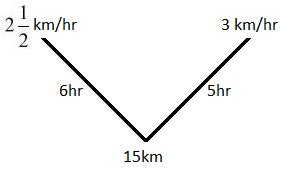
= 6 - 5 = 1 unit → $$\frac{16}{60}$$
15 units → $$\frac{16}{60}$$ × 15 = 4
∴ Required distance = 4 km
91. A train is moving at a speed of 80 km/hr and covers a certain distance in 4.5 hours. The speed of the train to cover the same distance in 4 hours is :
a) 100 km/hr
b) 70 km/hr
c) 85 km/hr
d) 90 km/hr
Explanation:In the first situation,
⇒ Total distance covered by train :
= 80 × $$4\frac{1}{2}$$
= 360 kms
⇒ Therefore,
The speed of the train to cover the same distance 360 km in 4 hours is :
$$\eqalign{ & = \frac{{360}}{4}\left\{ {{\text{Speed }} = \frac{{{\text{Distance }}}}{{{\text{Time}}}}} \right\} \cr & = 90{\text{ km/h}} \cr} $$
92. A constable is 114 metre behind a thief. The constable runs 21 metres per minute and the thief runs 15 metres in a minute. In what time will the constable catch the thief ?
a) 19 min
b) 18 min
c) 17 min
d) 16 min
Explanation:
$$\eqalign{ & {{\text{V}}_{{\text{rel}}{\text{.}}}} = \left( {21 - 15} \right){\text{ m/min}} \cr & \,\,\,\,\,\,\,\,\,\,\, = {\text{ 6 m/min}} \cr} $$
Time taken to catch the thief :
= $$\frac{114}{6}$$ min
= 19 min
93. A boy rides his bicycle 10 km at an average speed of 12 km/hr and travells 12 km at an average speed of 10 km/hr. His average speed for the entire trip is approximately :
a) 10.4 km/hr
b) 10.8 km/hr
c) 11.0 km/hr
d) 12.2 km/hr
Explanation:
$$\eqalign{ & {\text{Average speed }} = \frac{{{\text{Total distance }}}}{{{\text{Total time}}}} \cr & {\text{Average speed }} = \frac{{{\text{10 + 12 }}}}{{\frac{{10}}{{12}} + \frac{{12}}{{10}}}} \cr & {\text{Average speed }} = 10.8{\text{ km/hr}} \cr} $$
94. A student walks from his house at a speed of $$2\frac{1}{2}$$ km per hour and reaches his school 6 minutes late. The next day he increases his speed by 1 km per hours and reaches 6 minutes before school time. How far is the school from his house ?
a) $$\frac{5}{4}$$ km
b) $$\frac{7}{4}$$ km
c) $$\frac{9}{4}$$ km
d) $$\frac{11}{4}$$ km
Explanation:
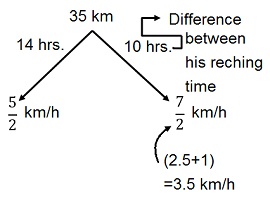
Difference between his reaching time :
= (14 - 10) hrs
= 4 hrs
= 4 hrs → 6m + 6m
(late + before)
= 4 hrs → 12 minutes
= 1 unit = $$\frac{12}{4 × 60}$$ km
($$\because $$ 1 m = 60 seconds)
1 unit = $$\frac{1}{20}$$ km
Then, 35 units :
= 35 × $$\frac{1}{20}$$ km
= $$\frac{7}{4}$$ km
Then the distance between his house and school is = $$\frac{7}{4}$$ km
95. A train 150 metres long takes 20 seconds to cross a platform 450 metres long. The speed of the train in, km per hour is :
a) 100 km/hr
b) 106 km/hr
c) 108 km/hr
d) 104 km/hr
Explanation:
$$\eqalign{ & {\text{Speed of train :}} \cr & = \frac{{450 + 150}}{{20}} \cr & = 30{\text{ m/s}} \cr & {\text{Speed (in km/hr):}} \cr & = 30 \times \frac{{18}}{5} \cr & = 108{\text{ km/hr}} \cr} $$
96. If a train with a speed of 60 km/hr. crosses a pole in 30 seconds. The length of the train (in metres) is :
a) 1000 metres
b) 900 metres
c) 150 metres
d) 500 metres
Explanation: The length of pole is considered as negligible i.e., = 0
i.e., when a train crosses the pole, it covers the distance equal to the length of train
So, the time will be taken by the train = 30 sec
And speed = 60 km/hr
Then the length of the train :
= 60 kmh × 30 sec
= 60 × $$\frac{5}{18}$$ × 30 metres
= 10 × $$\frac{5}{3}$$ × 30
= 500 metres
97. A man travelled a certain distance train at the rate of 25 kmph and walked back at the rate of 4 kmph. If the whole journey took 5 hours 48 minutes, the distance was :
a) 25 km
b) 30 km
c) 20 km
d) 15 km
Explanation:
$$\eqalign{ & {{\text{S}}_{{\text{average}}}} = \frac{{2ab}}{{a + b}} \cr & = \frac{{2 \times 25 \times 4}}{{25 + 4}} \cr & = \frac{{200}}{{29}}{\text{ km/hr}} \cr & {\text{Now, 2D = }}\frac{{200}}{{29}} \times \left( {5 + \frac{4}{5}} \right) \cr & = \frac{{200}}{{29}} \times \frac{{29}}{5} \cr & = 40{\text{ km}} \cr & {\text{ = D = 20 km}} \cr} $$
98. A man travelled a distance of 72 km in 12 hours. He travelled partly on foot at 5 km/hr and partly on bicycle at 10 km/hr. The distance travelled on foot is :
a) 50 km
b) 48 km
c) 52 km
d) 46 km
Explanation: According to the question,
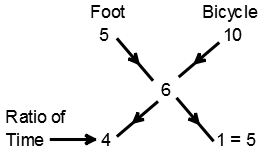
5 units → 12 hr
1 unit → $$\frac{12}{5}$$ hr and,
4 units → $$\frac{12}{5}$$ × 4
= $$\frac{48}{5}$$
Distance travelled on foot :
= $$\frac{48}{5}$$ × 5
= 48 km
99. A car can finish a certain journey in 10 hours at a speed of 42 kmph. In order to cover the same distance in in 7 hours, the speed of the car (km/h) must be increased by :
a) 12 km/hr
b) 15 km/hr
c) 18 km/hr
d) 24 km/hr
Explanation: Total distance :
= 42 × 10
= 420 km
New given time = 7 hr and
Required new speed :
= $$\frac{420}{7}$$ km/hr
= 60 km/hr
∴ Required increase in speed :
= (60 - 42) km/hr
= 18 km/hr
100. Two cars start at the same time from in point and move alone two roads, at right angle to each other. The speeds are 36 km/hr and 48 km/hr respectively. After 15 sec distance between them will be :
a) 400 m
b) 150 m
c) 300 m
d) 250 m
Explanation:
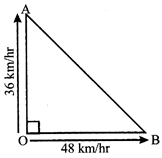
Distance travelled by the 1st car in 15 seconds
$$\eqalign{ & {\text{OA}} = \left( {36 \times \frac{5}{{18}}} \right) \times 15\,{\text{m}} \cr & \,\,\,\,\,\,\,\,\,\,\, = 150\,{\text{m}} \cr} $$
Distance travelled by the 2nd car in 15 seconds
$$\eqalign{ & {\text{OB}} = \left( {48 \times \frac{5}{{18}}} \right) \times 15\,{\text{m}} \cr & \,\,\,\,\,\,\,\,\,\, = 200\,{\text{m}} \cr} $$
∴ Distance between them after 15 seconds
$$\eqalign{ & {\text{AB}} = \sqrt {{\text{O}}{{\text{A}}^2} + {\text{O}}{{\text{B}}^2}} \cr & \,\,\,\,\,\,\,\,\,\, = \sqrt {{{150}^2} + {{200}^2}} \cr & \,\,\,\,\,\,\,\,\,\, = \sqrt {22500 + 40000} \cr & \,\,\,\,\,\,\,\,\,\, = \sqrt {62500} \cr & \,\,\,\,\,\,\,\,\,\, = 250\,{\text{m}} \cr} $$